Tuesday, January 6, 2015

Thriller Opening: Defining And Reaching Our Audience

For our thriller opening we need to have a specific audience that we want to target and reach out to. As a group we sat down to think about the different groups of people that we felt most suited to the plan of our thriller.

We concluded that we should aim for an audience roughly our age. As a certificate, we believe we would give our thriller an age rating of 15, therefore we can explore mature ideas and thriller conventions without being too explicit or inappropriate. Our thriller target audience is also aimed at the niche audience of late teens, the thriller targets those who take for granted the comfort of their own home, the safety of familiarity by turning everyday fears into a reality. Using the film Mirrors as an initial model to play on the audiences fears we can create a sense of realistic horror, this would be scarier than making a monster-thriller and we can experiment greatly with readily available items such as mirrors, beds and wardrobes.

We decided we would reach our audience by advertising primarily on Netflix and after shows such as ''The Fall'' and ''Sherlock'' by creating a sequence of clips that are aimed to access deep-rooted phobias and horrors of the past. By getting a contract with Google and websites we could use cookies and key words so whenever somebody types in “phobias” or “clowns” somebody expressing their fears, they see an advertisement for Under The Bed, this will fear and interest them. Using demographics we can reach young adults 15 to 20 year olds by advertising based on our common audiences interest. For example 8pm until 11pm on BBC3 and Channel 5 frequently to extensively hit our target audience.

  To advertise we could use a guerrilla marketing scheme where we place people’s obvious fears in public places in an attempt to scare them and advertise our film more. Using word of mouth and viral marketing with video clips and this unique idea buzz would get generated easier.

Technically we could begin with a montage of people’s phobias; spiders and clowns, heights and being buried alive, this will immediately set the tone and register of the film, it’s psychologically teasing and will intrigue a lot of the audience initially. Followed by the quote “an eye for an eye makes the entire world blind” by Gandhi which is the metaphor and theme, notion and morals behind the creation of Under The Bed.


Monday, December 8, 2014

The Kuleshov Effect

The Kuleshov Effect is the idea that the cut away in a scene can change the meaning of a simple emotion. This helps viewers to derive a deeper meaning from a sequence of shots rather than just watching it and experiencing the expected emotion.

 Me, Oliver and Jake attempted to create our own version of the Kuleshov Effect, using simple scenes that ultimately displayed different emotions. We did this as we thought it was important to understand the use of cutaways and how they can shape a scene before filming our thriller opening for our AS Coursework.


 ''The Kuleshov Effect is a film editing (montage) effect demonstrated by Russian filmmaker Lev Kuleshov in the 1910s and 1920s.It is a mental phenomenon by which viewers derive more meaning from the interaction of two sequential shots than from a single shot in isolation.'' http://en.wikipedia.org/wiki/Kuleshov_Effect

I feel we successfully managed to create a Kuleshov experiment that changed the meaning of the smile with the use of 3 independent cutaways that all held different meanings. Another famous example of the Kuleshov Experiment is Alfred Hitchcock's video...


Thursday, December 4, 2014

Thriller Opening: Storyboard

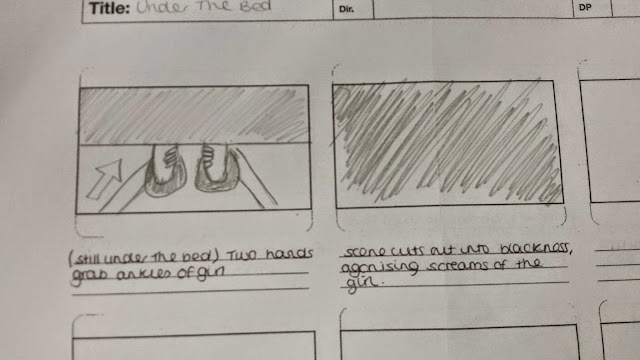
 We decided to storyboard our favourite idea for our thriller opening in order of planning ahead our shots and timings. I personally like our, ''Under The Bed'' idea as it plays on peoples security and comforts and regresses back to the childhood fear of a ''monster'' being under the bed. Our rough ideas show the story of an ordinary girl who goes home on a typical night and is met by a sudden and unexpected fear coming from underneath the bed.
 

Wednesday, December 3, 2014

Steven Spielberg: Thriller Director

Steven Spielberg is considered to be one of the most influential film personalities and one of Hollywood's best known directors. One of the wealthiest film makers, Spielberg has countless big-grossing, critically acclaimed credits to his name, as both producer, director and writer. Directing films such as Jurassic Park, Jaws and Munich, Spielberg has worked up a reputation of being credited and diverse within the three strong areas of filmmaking.

Spielberg was massively credited for his efforts in both Jaws and Jurassic Park, two of the biggest blockbusters to date. In a career spanning more than four decades, Spielberg's films have covered many themes and genres. In later years, his films began addressing humanistic issues such as the Holocaust, the transatlantic slave trade, war, and terrorism. For example, Spielberg's efforts in his creation of Schindler's List explores the historic past of Nazi Germany and the persecution inflicted on the Jewish population. This film won Spielberg the Academy Award for Best Director along with 126 awards from 231 nominations, including 3 Oscars, (two times for Best Director), 7 Golden Globes (two times for Best Director, three times as producer) and 11 Emmys.


Audience Theories

The Hypodermic Needle Theory


The Hypodermic Needle Theory or Hypodermic Syringe Model implies that mass media has a direct, immediate and powerful impact on the audience. This theory also implies that the viewer absorbs the information without any attempt to process or give the information context. The Hypodermic Needle Theory suggests that the media massively influences its audience without their direct consent or conscious knowledge of it doing so. For example, editing can be used to make audiences interpret things in certain ways without them applying a direct opinion to the matter.

Culmination/Cultivation Theory

The Cultivation Theory divides an audience into ''Heavy Viewers'' and ''Light Viewers''. ''Light Viewers'' are those who watch television for less than 4 hours a day, and ''Heavy Viewers'' are those who watch television for 4 hours or more. Heavy Viewers are affected by the Mean World Syndrome, where they believe the world is nastier than it actually is. This led Chandler to suggest that ''The more we live with TV, the more invisible it becomes'' believing that our exposure to television actively changes our view on things. For example, if an audience regularly indulges in violent programmes, they will begin to believe that it is socially acceptable to be more violent.  

Uses And Gratifications Theory

This theory suggests that an audience will use media texts for several different reasons. An audience may use one of these texts for one or several of the following:

  • Diversion - This is the idea that a person will use a media text to escape everyday life and reality. For example, an person may regularly watch a soap opera to escape from their own problems/stresses and temporarily lose themselves in the light-hearted on-goings of a fictional character.

  • Personal Identity - A person may also use media texts to identify with themselves and to find themselves in a character they can relate to.

  • Personal Relationships - This is the idea of using media texts for social interaction and to enjoy a specific area of the media with others. For example, many may watch a programme for the interactions with friends or family purely for the conversation or unity that comes with giving time to watch the programme itself.

  • Surveillance - Documentaries and News programmes supply this type of connection with media texts. Surveillance relates to the idea of using the media to receive information.


  • Entertainment - This is the most widely used connection with media. Many people will use media texts after a long day as a way of entertaining themselves after the usual daily routine. This is the reason behind many game shows and talent shows such as: The X Factor, I'm A Celebrity... Get Me Out Of Here and The Chase.


Thursday, November 27, 2014

Researching The Film Industry

By researching the industry, I have allowed myself to understand the process of which a film must go through in order of becoming open to the public. This will help me to understand how I must structure my thriller opening and how I must use editing and post-production effectively to create an opening that captures the audience. 

Monday, November 24, 2014

Textual Analysis: Se7en


This textual analysis focuses on the opening, and first few scenes of the thriller film, 'Se7en' by David Fincher. This textual analysis will help me to understand what makes a good thriller and how I can add these effects and ideas into my own thriller opening for my coursework.