As a group we took these criticisms into account and made a point of noting them down so that we could improve them when it came to our coursework thriller task. We also agreed with what Tasmine had said in the video as we had noticed these points when evaluating ourselves after the preliminary had been filmed, and put online.
Showing posts with label 2. Preliminary Task. Show all posts
Showing posts with label 2. Preliminary Task. Show all posts
Tuesday, November 4, 2014
Preliminary Task: Video Review
I asked a member of another group to review our preliminary task. I felt it was important to ask others to give us feedback as they would be none biased and honest. I asked Tasmine to give us three points to improve our preliminary piece and three points that went well.
As a group we took these criticisms into account and made a point of noting them down so that we could improve them when it came to our coursework thriller task. We also agreed with what Tasmine had said in the video as we had noticed these points when evaluating ourselves after the preliminary had been filmed, and put online.
As a group we took these criticisms into account and made a point of noting them down so that we could improve them when it came to our coursework thriller task. We also agreed with what Tasmine had said in the video as we had noticed these points when evaluating ourselves after the preliminary had been filmed, and put online.

Saturday, November 1, 2014
Preliminary Task: Evaluation
I decided to do my evaluation as a powerpoint presentation as another way of exploring different types of skills and media. I also have a video of a review of my video, however, I felt like this should be put up as a separate post.
Preliminary Task: The Final Piece
Here's our final piece for the preliminary task. We managed to include each aspect from our brief, such as: 180 degree rule, match on action, continuity and shot-reverse shot. I am happy with how this piece has developed and become a short clip of film that manages to keep to the brief, whilst also exploring a short storyline.
Our clip follows an assassin into an ''interview'' with an assassination company. The assassin is played by myself and the interviewer by Oliver. Due to the changes to our original plan, we stepped in to play the characters and move the piece onto post production.
We had a few errors in post production however, after finishing the final edit, our computer experienced some problems which meant our whole piece was deleted. We fixed this by exporting all our clips onto a new computer and starting again. This ultimately meant we did not have time to put the music on our piece and therefore felt it was not as good as it could have been.
Despite this, we submitted our final piece, and we are relatively happy with the outcome.
Tuesday, October 21, 2014
Preliminary Task: Location Scouting
For the short piece of film we have been asked to make, we need a specific type of location that can be seen as both professional and eery at the same time. Me, Jake and Oliver took some time to photograph various different rooms that we thought may be suitable for the interview of the assassin.
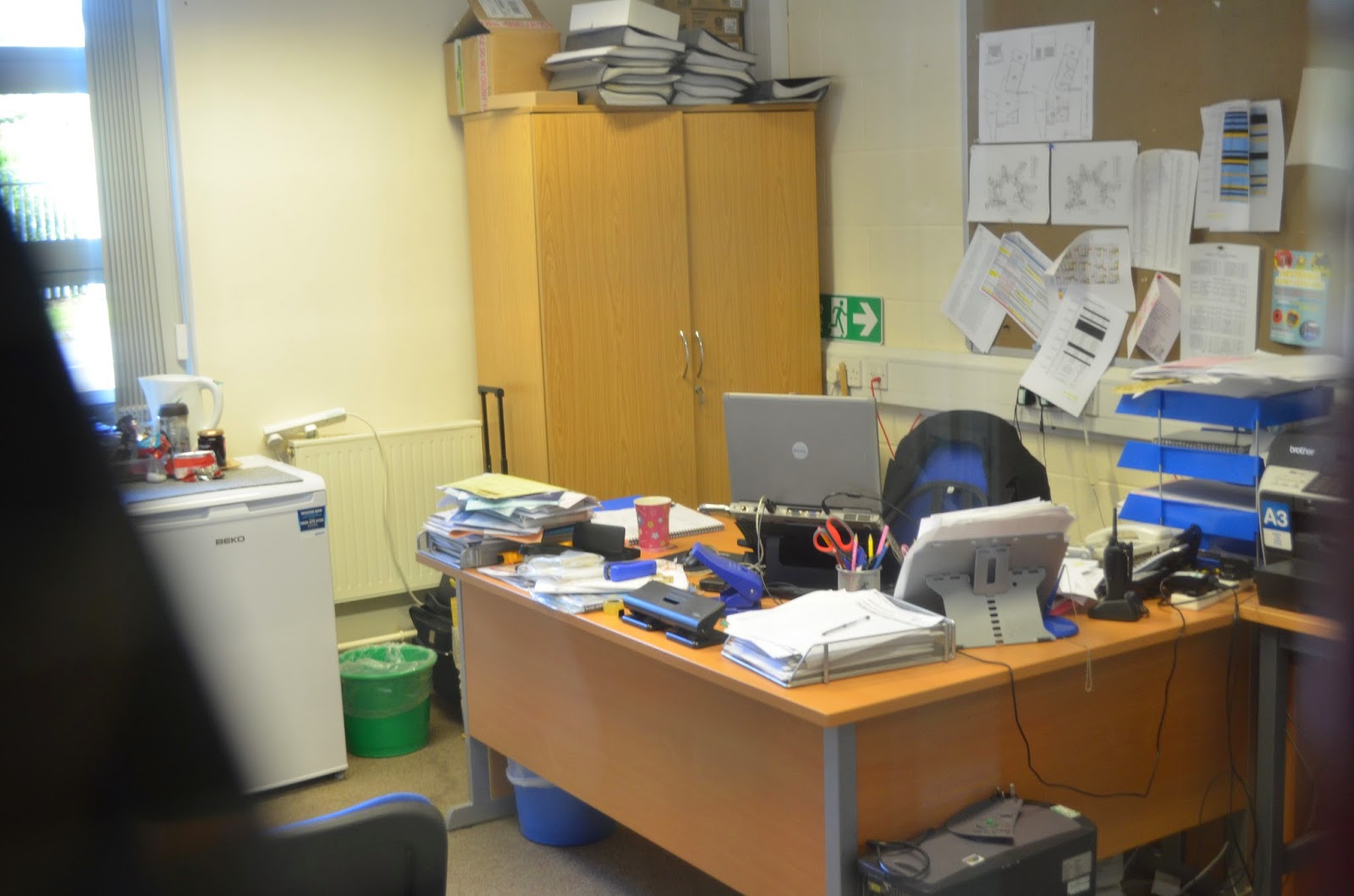
This space has the ideal kind of professional look that we would require for our interview. The desk space would allow us the get the sort of shots that we have planned (for example: shot/reverse shot). However, the background did not look suitable for an assassin to conduct an interview in.

 We initially like the darkness of this room and how sinister it could look under the correct light. The light creeping in through the window makes the whole room look more intense. The only problem of this room as that it would be hard to find an angle that would not involve the English displays on the wall.
The files on the shelves and paperwork scattered around the room gives the impression that the assassin has a lot of contacts and paperwork for the acts he has carried out. This is ideal for the type of shot we want to create. The only downside to this room is that the desk does not has access from both sides, therefore we would have to change the shots that we plan to use.

The slightly messy look of this room is ideal for the overall look and atmosphere we want to create. The room, however, is slightly small and would be difficult to get both the actors and cameras in without creating too many continuity errors. We would also have to move the room around to fit in a desk which would be time consuming.
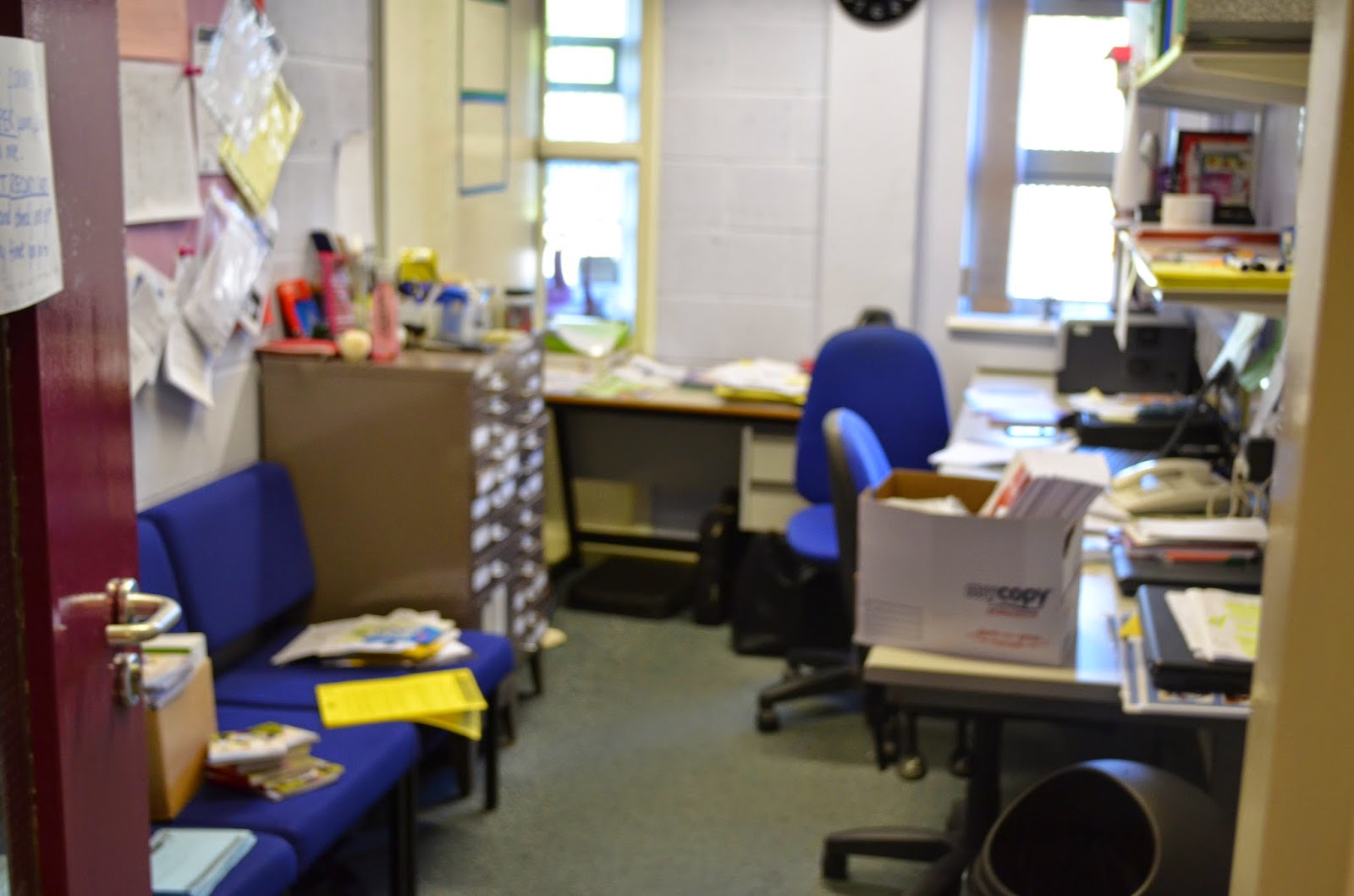
The sixth form office was a room we had considered. We were slightly worried of the availability of this room, and whether it would be free for a period of time long enough to film. Although the room could work well for the assassins interview, the availability would be an issue.

The computers around this room suggest that there is a whole network of people working for the assassin. However, putting a desk in the middle of the room might look rather awkward and out of place. For this room we would also have to consider angles and whether the window would create potential light issues.
 The dance studio is, personally, my favourite room to film in. I like the background with the punching bags as I feel this would make the assassin look stronger and more superior within the scene. I also like the idea that the room is slightly oversized to be an office. It makes it look as if the assassin works from another secret location that is not stereotypical of an interview.
Our immediate thoughts were that we needed a room that looked like and office, or that could be transferred into one. Finding the right type of room for this was rather difficult as we had to consider lighting issues, availability of the room, and if we could get access to different parts of the room to gather the relevant camera shots. We photographed various different options as seen below.
This space has the ideal kind of professional look that we would require for our interview. The desk space would allow us the get the sort of shots that we have planned (for example: shot/reverse shot). However, the background did not look suitable for an assassin to conduct an interview in.
We initially like the darkness of this room and how sinister it could look under the correct light. The light creeping in through the window makes the whole room look more intense. The only problem of this room as that it would be hard to find an angle that would not involve the English displays on the wall.The files on the shelves and paperwork scattered around the room gives the impression that the assassin has a lot of contacts and paperwork for the acts he has carried out. This is ideal for the type of shot we want to create. The only downside to this room is that the desk does not has access from both sides, therefore we would have to change the shots that we plan to use.
The slightly messy look of this room is ideal for the overall look and atmosphere we want to create. The room, however, is slightly small and would be difficult to get both the actors and cameras in without creating too many continuity errors. We would also have to move the room around to fit in a desk which would be time consuming.
The sixth form office was a room we had considered. We were slightly worried of the availability of this room, and whether it would be free for a period of time long enough to film. Although the room could work well for the assassins interview, the availability would be an issue.
The computers around this room suggest that there is a whole network of people working for the assassin. However, putting a desk in the middle of the room might look rather awkward and out of place. For this room we would also have to consider angles and whether the window would create potential light issues.
Preliminary Task: A Change Of Plan
Our initial planning for filming required two members of teaching staff within the sixth form. As we came to plan and organise our time we came across some issues with this. The members of staff who had originally agreed to be in our piece of film both realised they were not as available as they originally thought and were usually both free at different times.
Instead of seeing this as a drastic issue, our group decided we would take over the acting ourselves. Although this would mean sharing the jobs and filming of editing while also managing our time to actually act in our film, it meant the process of creating the preliminary task would be more efficient and easier to organise our filming time around us rather than two individuals with a lot of responsibility in other areas.
It was decided that me and Oliver would become the two characters. Oliver would take over the role of the Interviewer and myself as the Assassin who was being interviewed for the job. With both mine and Oliver's schedule being similar, and having the same non-contact periods within school time, it made meeting up a lot easier. One issue we did discover was that Jake had other commitments and was not as available. Despite this, me and Oliver continued to film. It also became apparent that we may have to change a few shots that we had planned on our storyboards as they no longer fit or looked natural.
Overall, I feel that our decision to change the actors within the film will be more beneficial and easier to manage.
Preliminary Task: Script Writing
In the pre-production stage for our preliminary task, Oliver, Jake and I decided to create a script that would be used within our clip as the lines of dialogue for the actors. We felt that creating a script would enhance the realism of the film, and make the dialogue flow better and more naturally. We all felt a script was essential in order to keep things organised and well planned, and also it served as good practice for us in our scriptwriting skills.
Each character will receive a copy of the script to ensure effectiveness in filming and time management.

Friday, September 26, 2014
Preliminary Task: Planning
As part of our preliminary task, we were asked to storyboard the sequence of shots we were going to use to create our 2 minute clip. Our group came up with the idea of creating a situation that involved a job interview. However, as a practice for our coursework we decided to create an interview that was quite tense and based on a "thriller" type story. The storyboard below shows how we intend to create a short piece of film that follows an interview for an assassin...
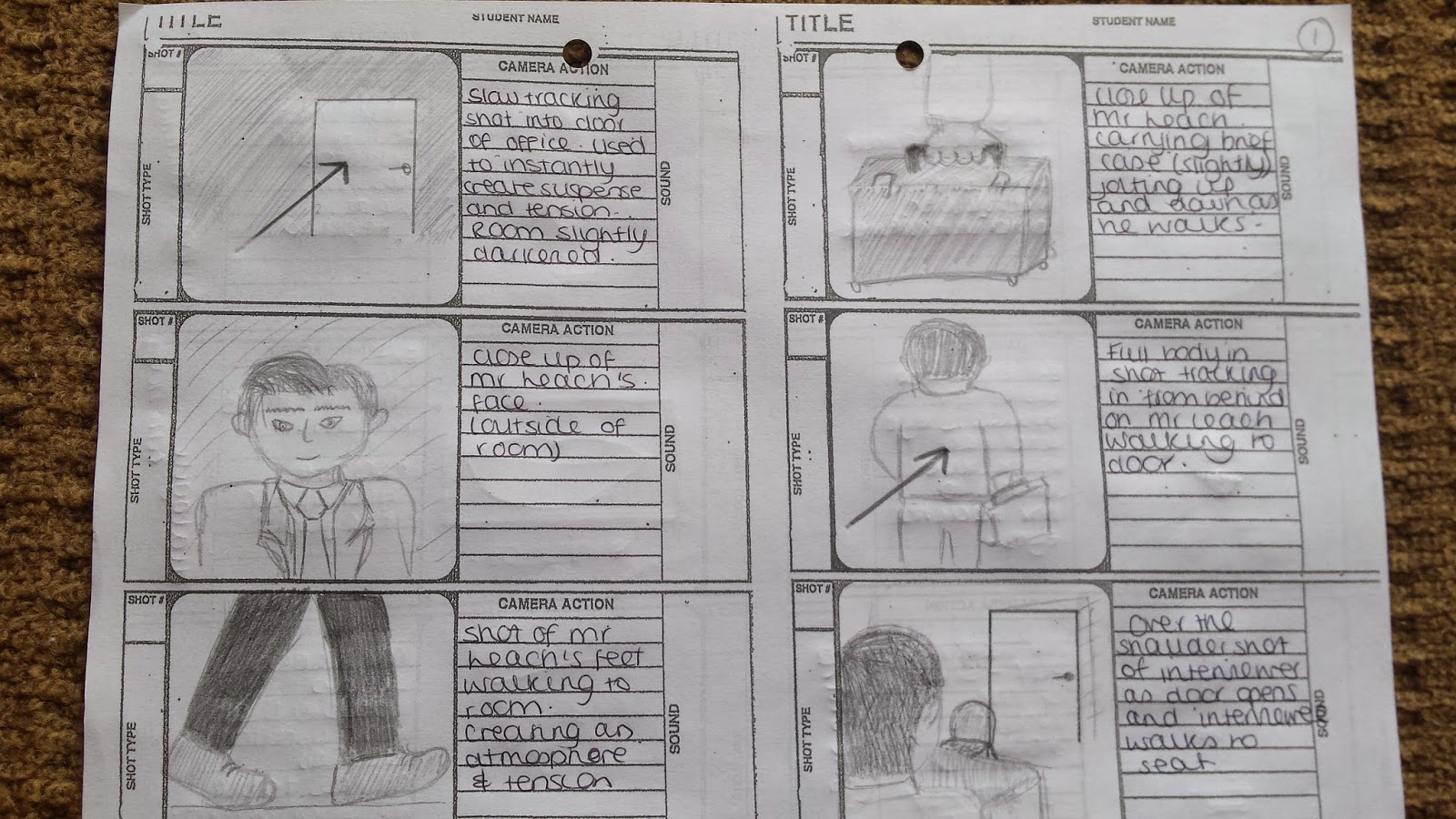 Even though our

Even though our
storyboards are not brilliantly drawn, we are able to capture each shot that we will need to create the type of genre and tension that we expect from our clip. The storyboard is also useful as it gives brief description of how to shots may pan or track and what sort of frame we will use.
The storyboards mean that we will not miss shots accidentally as we have a detailed plan of what shots are needed and in what sequence. The storyboard is also helpful to understand how much of the shot we need to cover the background and where the camera should be to ensure the character is in the centre of the frame.
The storyboards we have created will make filming and keeping on track a lot easier than if we just worked from memory. The storyboard also helps us to track our progress and discover which shots work and which don't without having to remember which shots we have tried.
Saturday, September 20, 2014
Preliminary Brief: Continuity Task
We have been set a preliminary task in which we must film a short clip using continuity techniques. The clip of film must show a character opening the door, crossing the room and sitting down opposite another character where a few lines of dialogue will be exchanged. The task must involve: match on action, 180 degree rule, and examples of shot/reverse shot.
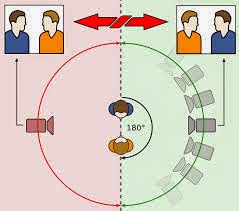 180 Degree Rule: The 180 Degree Rule is a simple guideline that means that 2 characters or objects in a scene should have the same left/right relationship to each other. This rule refers to the spatial awareness of those in the scene. The camera must stay on the same side of the imaginary line, known as the axis, in order for these shots to work.

Match On Action: This refers to an editing technique where the editor cuts from one shot to another whilst still matching the action of the previous shot. Despite the fact that these shots will have been filmed separately, match on action gives the impression of continuous time when the film is put together. This type of editing has to look seamless to be successful.
180 Degree Rule: The 180 Degree Rule is a simple guideline that means that 2 characters or objects in a scene should have the same left/right relationship to each other. This rule refers to the spatial awareness of those in the scene. The camera must stay on the same side of the imaginary line, known as the axis, in order for these shots to work.
Shot Reverse Shot: This is also a continuity editing technique that is usually used in conversations between characters. This shot cuts from one person to another as the conversation progresses. This helps the viewer to see the characters as facing each other and helps the scene look more natural.
For this task I have teamed up with Oliver and Jake, we have all agreed to make our clip quite tense and serious as a practice for the thriller opening sequence that will be graded for our coursework.
Subscribe to:
Posts (Atom)