Showing posts with label 3. Research And Planning. Show all posts

Monday, February 2, 2015

Textual Analysis:Red Lights (2012)

This textual analysis focuses on the opening scenes to the 2012 film, Red Lights by title designer Jorge Calvo. By analysing this title sequence, I will be able to assess what works well for a title sequence and what does not represent or ''fit in'' with the storyline. This title sequence will also give me idea of what route I would like to go down with my title sequence. 


Synopsis

Dr. Margaret Matheson and her partner, Tom Buckley are the world's foremost investigators of paranormal phenomena. Professional sceptics, they have debunked dozens of fraudulent mind readers, ghost hunters, faith healers and the like by detecting what Matheson calls red lights, subtle clues to the trickery behind each of these supernatural occurrences.

But when the legendary blind psychic Simon Silver comes out of retirement after 30 years, his once-fearless adversary Matheson warns Buckley to back off. Suspecting that the charismatic, spoon-bending mind reader was involved in the mysterious death of his most vociferous critic three decades earlier, she considers him far too dangerous to confront.


source: http://www.imdb.com/title/tt1748179/synopsis

Red Lights (2012) - Art Of The Title


Firstly, the title sequence starts rather plainly, with just a few key names of those involved in the film appearing on a black background. Following this a pair of hands appears within a small spot light, behind the text, becoming the key feature of the shot and adding just a small amount of white, creating a sense of some good intention or ''heavenly'' aspect to the film. The shadow of the hands is, however, quickly replaced by the dark background and white text almost immediately after it appears, only accounting for a few seconds of the title sequence before it is abruptly cut and the titles of actors continues. The use of this shot may also suggest that the story is going to based on a specific individual in which others are interested or who has a significant story to tell.


When the title of the film is actually shown, the reappearing white ''lense-flare'' type lighting turns to red, obviously matching the name of the title. The lights are shown to be both focused and unfocused potentially suggesting that the storyline is not all it seems and is connected by ideas that are certain and motives that are slightly less certain or unclear to those in the plot, creating the perfect thriller storyline of uncertainty, danger and leads that both follow the plot and create dramatic plot twists. The title ''Red Lights'' refers to the idea in the plot line of two investigators of paranormal phenomena, who are professional sceptics,  chasing down fraudulent mind readers, ghost hunters, faith healers, etc, and finding their ''red lights'' - subtle clues to the trickery behind each of these supernatural occurrences.


A main focus of the title sequence is an eye, in which we only see the pupil and iris against the dark background. By only seeing this part of the eye, so deep and closely, there could be connotations to the idea of the film following the supernatural profession and how they are associated with ''seeing into the future'', ''seeing into the past'' and ''seeing into the soul''. This would create the effect of hinting towards the audience that they are going to see the ideas but in a different way than they anticipate. For example, the background and the pupil are both black without any kind of detail, this could suggest that the audience are going to see the darker side of the supernatural and experience truths that they would have never have associated with the profession in a negative light. The feature of only black and white colours could also support this idea. 


Another symbol displayed in the title sequence is a crucifix. This could symbolise that the supernatural is linked to the doctrine of creation, religion and the creator, God. For example, the idea of ghosts and spirits links into the idea of a heaven, hell and purgatory (a place between Heaven and Hell, where the soul is not bad enough to be sent to an eternity of damnation in Hell, but not good enough to go to Heaven, so it is sent there temporarily where the person suffers, and is purified so that it can be sent to Heaven). The crucifix could also symbolise purity, which the two investigators are trying to achieve by chasing down the fraudulent professionals within the business and removing them of their ''red lights''.


 Possibly following the idea of ghosts and spirits, Jorge Calvo then adds a male face the sequence, which is continuously moving and blurring to create the blurred polaroid below. The face looks rather fierce and angry, perhaps a ghost or spirit that is hunted by the ghost hunters, using the polaroid photo for evidence of his existence. The male is also very stern
 and unforgiving in his looks, possibly creating a sense of a ''red light''. The fact that the picture is also a polaroid photo implies that those who are part of the paranormal profession stick to the old traditional way of doing things, with the added motive of their ''red lights'' that create a cheat way of performing their talent. 

The blurred photograph has a lack of features to create the ''ghost-like'' look that the paranormal professionals are hunting, however this lack of features may also suggest that the profession is a con as clearly no identity can be found from this photograph and no specifics are revealed. 


The non-diegetic music that accompanies the title sequence is quite discordant and creates tension to add to the array of  different objects and images flashed up throughout the opening. The music is very typical of a thriller film, very strong/regal but with hints of little sounds or noises that make the audience feel uncomfortable or build tension before the film has even started. This title sequence involves sounds high pitched tones, possibly supplied by a violin, to create an uncomfortable atmosphere and also uses a drum beat to keep the pace of the opening sequence.

Wednesday, January 28, 2015

Thriller Opening: Filming Day 3

The aim of today's shooting schedule was to film all the indoor shots needed for our piece. We filmed our shots in the interior of my house, and used my sisters room to film in, due to it being more appropriate for the story line. We also used the satanic symbols, drawn by a friend, in the room to hint at the idea of the ''thing'' under the bed being more than just a coincidence. 

We managed to film all the shots we intended to and stuck to the shots on the shooting schedule. We were also able to experiment with the mirror and how we could create different meanings with use of the mirror from different angles. We were also able to experiment with shots from within the wardrobe and the room altogether before the character had even entered, which gave our thriller opening more depth due to the fact that we had tried this alternative shots, rather than the average midshot.

We didn't problems with filming, apart from the fact that Jake couldn't make it, as we had planned carefully how we would work around things. The only challenging aspect was trying to ensure the cat did not ruin shots by making noises whilst we were filming, which occasionally proved difficult due to the fact that Oliver was new to him and he was intrigued. Overall, filming went very smoothly and we filmed the correct amount of shots to finish our film as well as some surplus shots to experiment with.

Thriller Opening: Filming Day 2

The location of filming today was the street that I live on as we needed to continue to film the journey home of the female character, and it made more sense to do this in this location (as we will be filming inside my house) than use a different location and try to fit the exterior of my house into the context of that location.

We decided to keep this part of filming short and snappy, but with a lot of extra shots as both Jake and Oliver lived in different areas and would need to find alternative ways of getting home. 

We started off by filming our female character walking up the street, filming at roughly the same time for continuity in the darkness if the scene, and walking to the house. We shot many different angles and ways of creating this journey so we would have many different options when it came to sequencing our film and putting together our final piece. 

We also got shots of the character opening the door and going inside as we thought this would complete the journey, rather than filming it when we filmed the inside shots, as it would be better for continuity and made more sense with the flow of what we had filmed already. 

Much of the filming done today was central to getting the last part of the journey done before continuing to film the indoor shots.

Sunday, January 18, 2015

Thriller Opening: Filming Day 1

We planned to film our thriller at roughly 5.30pm and film until we felt the lighting was not longer appropriate for the scene or until it was too dark to create any affect.

Unfortunately, Jake could not make this day of filming due to other commitments, so Oliver and I headed into the town centre to film part one of our outdoor shots. We took the basic equipment we needed (DSLR Nikon Camea, LED Light attachment for DSLR, standard tripod) to the location we had decided best to create the best feel and tension for the storyline.

We decided to film down by our local theatre as it had quite a sinister feel, and led to a bridge which we felt we could get some good shots on to coincide with our idea of harnessing peoples fears. These shots would be used for the first 45seconds (approx.) of our film and will follow the journey home of our character (a 17 year old girl).

We managed to film all our outdoor shots for this part of the journey without any problems, despite having to work around the public and them commuting home. We filmed a lot more shots than we needed for our thriller and shot many of the same shots a few times so that we could choose the best looking one for the final sequence of our thriller. However, our footage looks rather yellow due to the street lights in the area so we will need to alter the colour and saturation of the clips before rendering and exporting the final piece.

Overall, filming went as planned and did not cause any problems for us or the storyline of our film.

Wednesday, January 14, 2015

Regional Identity

For our thriller opening, we need to consider the way that our regional identity will affect the way the thriller is interpreted by others. Although the regional identity of our piece cannot be changed, we need to make sure it makes sense to the story line and fits in with the mise-en-scene.

Below I studied a few regional identities and how they are represented now, compared with the past.


Tuesday, January 6, 2015

Thriller Opening: Defining And Reaching Our Audience

For our thriller opening we need to have a specific audience that we want to target and reach out to. As a group we sat down to think about the different groups of people that we felt most suited to the plan of our thriller.

We concluded that we should aim for an audience roughly our age. As a certificate, we believe we would give our thriller an age rating of 15, therefore we can explore mature ideas and thriller conventions without being too explicit or inappropriate. Our thriller target audience is also aimed at the niche audience of late teens, the thriller targets those who take for granted the comfort of their own home, the safety of familiarity by turning everyday fears into a reality. Using the film Mirrors as an initial model to play on the audiences fears we can create a sense of realistic horror, this would be scarier than making a monster-thriller and we can experiment greatly with readily available items such as mirrors, beds and wardrobes.

We decided we would reach our audience by advertising primarily on Netflix and after shows such as ''The Fall'' and ''Sherlock'' by creating a sequence of clips that are aimed to access deep-rooted phobias and horrors of the past. By getting a contract with Google and websites we could use cookies and key words so whenever somebody types in “phobias” or “clowns” somebody expressing their fears, they see an advertisement for Under The Bed, this will fear and interest them. Using demographics we can reach young adults 15 to 20 year olds by advertising based on our common audiences interest. For example 8pm until 11pm on BBC3 and Channel 5 frequently to extensively hit our target audience.

  To advertise we could use a guerrilla marketing scheme where we place people’s obvious fears in public places in an attempt to scare them and advertise our film more. Using word of mouth and viral marketing with video clips and this unique idea buzz would get generated easier.

Technically we could begin with a montage of people’s phobias; spiders and clowns, heights and being buried alive, this will immediately set the tone and register of the film, it’s psychologically teasing and will intrigue a lot of the audience initially. Followed by the quote “an eye for an eye makes the entire world blind” by Gandhi which is the metaphor and theme, notion and morals behind the creation of Under The Bed.


Monday, December 8, 2014

The Kuleshov Effect

The Kuleshov Effect is the idea that the cut away in a scene can change the meaning of a simple emotion. This helps viewers to derive a deeper meaning from a sequence of shots rather than just watching it and experiencing the expected emotion.

 Me, Oliver and Jake attempted to create our own version of the Kuleshov Effect, using simple scenes that ultimately displayed different emotions. We did this as we thought it was important to understand the use of cutaways and how they can shape a scene before filming our thriller opening for our AS Coursework.


 ''The Kuleshov Effect is a film editing (montage) effect demonstrated by Russian filmmaker Lev Kuleshov in the 1910s and 1920s.It is a mental phenomenon by which viewers derive more meaning from the interaction of two sequential shots than from a single shot in isolation.'' http://en.wikipedia.org/wiki/Kuleshov_Effect

I feel we successfully managed to create a Kuleshov experiment that changed the meaning of the smile with the use of 3 independent cutaways that all held different meanings. Another famous example of the Kuleshov Experiment is Alfred Hitchcock's video...


Thursday, December 4, 2014

Thriller Opening: Storyboard

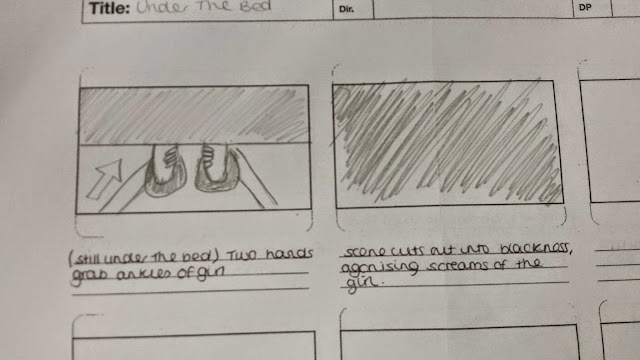
 We decided to storyboard our favourite idea for our thriller opening in order of planning ahead our shots and timings. I personally like our, ''Under The Bed'' idea as it plays on peoples security and comforts and regresses back to the childhood fear of a ''monster'' being under the bed. Our rough ideas show the story of an ordinary girl who goes home on a typical night and is met by a sudden and unexpected fear coming from underneath the bed.
 

Wednesday, December 3, 2014

Steven Spielberg: Thriller Director

Steven Spielberg is considered to be one of the most influential film personalities and one of Hollywood's best known directors. One of the wealthiest film makers, Spielberg has countless big-grossing, critically acclaimed credits to his name, as both producer, director and writer. Directing films such as Jurassic Park, Jaws and Munich, Spielberg has worked up a reputation of being credited and diverse within the three strong areas of filmmaking.

Spielberg was massively credited for his efforts in both Jaws and Jurassic Park, two of the biggest blockbusters to date. In a career spanning more than four decades, Spielberg's films have covered many themes and genres. In later years, his films began addressing humanistic issues such as the Holocaust, the transatlantic slave trade, war, and terrorism. For example, Spielberg's efforts in his creation of Schindler's List explores the historic past of Nazi Germany and the persecution inflicted on the Jewish population. This film won Spielberg the Academy Award for Best Director along with 126 awards from 231 nominations, including 3 Oscars, (two times for Best Director), 7 Golden Globes (two times for Best Director, three times as producer) and 11 Emmys.


Audience Theories

The Hypodermic Needle Theory


The Hypodermic Needle Theory or Hypodermic Syringe Model implies that mass media has a direct, immediate and powerful impact on the audience. This theory also implies that the viewer absorbs the information without any attempt to process or give the information context. The Hypodermic Needle Theory suggests that the media massively influences its audience without their direct consent or conscious knowledge of it doing so. For example, editing can be used to make audiences interpret things in certain ways without them applying a direct opinion to the matter.

Culmination/Cultivation Theory

The Cultivation Theory divides an audience into ''Heavy Viewers'' and ''Light Viewers''. ''Light Viewers'' are those who watch television for less than 4 hours a day, and ''Heavy Viewers'' are those who watch television for 4 hours or more. Heavy Viewers are affected by the Mean World Syndrome, where they believe the world is nastier than it actually is. This led Chandler to suggest that ''The more we live with TV, the more invisible it becomes'' believing that our exposure to television actively changes our view on things. For example, if an audience regularly indulges in violent programmes, they will begin to believe that it is socially acceptable to be more violent.  

Uses And Gratifications Theory

This theory suggests that an audience will use media texts for several different reasons. An audience may use one of these texts for one or several of the following:

  • Diversion - This is the idea that a person will use a media text to escape everyday life and reality. For example, an person may regularly watch a soap opera to escape from their own problems/stresses and temporarily lose themselves in the light-hearted on-goings of a fictional character.

  • Personal Identity - A person may also use media texts to identify with themselves and to find themselves in a character they can relate to.

  • Personal Relationships - This is the idea of using media texts for social interaction and to enjoy a specific area of the media with others. For example, many may watch a programme for the interactions with friends or family purely for the conversation or unity that comes with giving time to watch the programme itself.

  • Surveillance - Documentaries and News programmes supply this type of connection with media texts. Surveillance relates to the idea of using the media to receive information.


  • Entertainment - This is the most widely used connection with media. Many people will use media texts after a long day as a way of entertaining themselves after the usual daily routine. This is the reason behind many game shows and talent shows such as: The X Factor, I'm A Celebrity... Get Me Out Of Here and The Chase.


Thursday, November 27, 2014

Researching The Film Industry

By researching the industry, I have allowed myself to understand the process of which a film must go through in order of becoming open to the public. This will help me to understand how I must structure my thriller opening and how I must use editing and post-production effectively to create an opening that captures the audience. 

Monday, November 24, 2014

Textual Analysis: Se7en


This textual analysis focuses on the opening, and first few scenes of the thriller film, 'Se7en' by David Fincher. This textual analysis will help me to understand what makes a good thriller and how I can add these effects and ideas into my own thriller opening for my coursework.


Sunday, November 16, 2014

Conventions Of A Thriller Film

A thriller usually consists of a battle between an antagonist and a protagonist that creates a deliberate disruption in the equilibrium. A chain of events creates tension and suspense leading up to the climax. (1)

Thrillers also consist of multiple subgenres. These are used within the plot of he film without the audience consciously thinking about their presence. These subgenres include:

Action Thriller: This uses physical action to uphold tension throughout the plot. This subgenre will often have continuous motion and physical stunts/chase scenes that contribute to the whole idea of the danger the protagonist faces.

Crime Thriller: A crime thriller usually relies on the plot of a serial killer, murderer, robbery or manhunt in order of creating suspense. Often the storyline will focus around both the antagonist and protagonist.

Film-Noir: Film-Noir is based around the popularity of a stylistic type of crime-drama or thriller in the 1940's and 1950's. As stated in the title, the film is edited into black and white.

Psychological Thriller: In this subgenre the threat comes from the mind, not the constant use of physical violence.The protagonists in psychological thrillers must rely on their mental resources to solve the situation

Science Fiction Thriller: These are based on the use of hypothetical sciece-based films. Often, this sub-genre will explore the “future-gone-bad” theme, including plots that revolve around alien invasions, dystopian scenarios, and super-diseases
 
Religious Thriller: This subgenre includes religious questions, ceremonies, and objects to revolve around a specific religion or religious view. Exorcisms, demon possession, and church cover-ups are typical themes of Religious Thrillers. (2)

Credits

  (1) http://www.slideshare.net/JasonsA2Media/codes-and-conventions-of-the-thriller-genre
  (2) http://thescriptlab.com/screenplay/genre/thriller


Friday, November 14, 2014

Thriller Opening: Initial Ideas

Me, Jake and Oliver had a discussion about what direction we wanted to go in for our thriller. We came up with several different ideas and different concepts for the opening scene. We noted down these ideas in a spider diagram and wrote a brief synopsis for each idea. We came up with both stereotypical ideas and ones that were less used. Out of all our ideas, our favourite concept was the 'Under The Bed'' idea where we would be able to use different camera shots to be able to create tensions, fear and suspense.


Monday, November 10, 2014

Barthes' Narrative Codes


Barthes came up with the theory that there are 5 narrative codes that explain all narrative texts. These codes are: Action Code, Mystery/Enigma Code, Semic Code, Cultural Code, and Code of Oppositions (Binary Code). Each code gives a different theory as to how a narrative hints different things towards the audience.

In our preliminary we subconsciously used several of these codes just from our knowledge of the genre of our piece. Without knowing it we had included examples of each code.


Action Code (Proairetic Code)
The Action Code is the idea that the audience will recognise an action and immediately associate it with the next logical step. This advances the narrative by leading the audience into the next piece of action. For example, a film may show the action of someone packing a suitcase. At this point the audience will automatically make the connection to the character leaving/going on a trip, just from the first initial action.
We used this code in our preliminary piece when we showed the assassin walking in through the door. We immediately led our audience into following the idea that the assassin would then enter another room in which more action would take place. As this was our only example of action code, we could have added extra actions that would automatically lead you to the next logical action. For example, as originally planned, we could have placed the contract, from the interviewer, in front of the assassin who has a pen in their hand. This would have led the audience to automatically assume that the assassin was going to sign the contract and commit himself to the job in hand.


Enigma Code (Hermeneutic Code)
The Mystery Code, or Enigma Code, is used to explain the narrative by controlling what information and how much information is supplied to the audience. This grabs the audience's attention and keeps them interested by setting up a mystery or problem they believed will be solved during the course of the narrative. Unanswered examples of enigma code also seem to frustrate audiences and create a talking point.
In our preliminary piece, we also used examples of mystery code throughout our use of dialogue. We never actually stated that our characters were assassins or that they were meeting about a potential job. We also purposely didn't mention what the job would be, to keep the audience interested and in anticipation throughout the narrative. I feel like we used this code rather well as we managed to create a sense of tension and anticipation in the final edit of the piece.

Semic Code
The Semic Code is all about signs and symbols that tells us/ give us hints about the characters or story line. For example, if an anarchy sign is purposely featured in a scene, it suggests that the next scene will include chaos and destruction.

We didn't use many examples of Semic Code in our preliminary piece of film. We could consider the fact that the antagonist was wearing dark clothes as an example of semic code. I feel like this was the weakest point for our preliminary. If I did it again, I would try to add an example that showed the assassin firm/ interviewer as a higher authority than the assassin/anatagonist themselves.

Cultural Code (Referential Code)
The cultural code is exactly as it says. This is the idea that the narrative can clearly display ideas such as time period and location, without specifically stating this. In our preliminary we unintentioanlly displayed codes of Britain due to our ethnicity, accents and language. These three principles suggest to the audience that we are British. I dont think there is any other way that we could have added extra signs of the location and time period.

Code Of Oppositions (Binary Opposites)
This code refers to the idea of binary opposites, such as black vs white, day vs night and ying vs yang. The only example we used of this in our preliminary task was that the two characters were opposite genders. Oliver, playing the interviewer, clearly contrasted with myself, although our characters seemed equal in strength. We could have added more examples of opposites in our piece.


http://www.learn.columbia.edu/saussure/

Saturday, November 8, 2014

Lighting Practice


 In order to create the perfect theme and tension for our thriller we decided to do some practicing with lighting and discover how it can change moods/scenes instantaneously. We borrowed a small LED camera light from the media department to take our shots. We decided to take our photos in the English store room as it was the darkest place we could find that would allow us to manipulate the light. 


Firstly, we held the camera at a high angle to create a rather angelic/ protagonist feel to the photo. This allowed us to experiment with how we could enhance a characters persona just by changing the lighting of a shot.


Then we tried to create a softer look, by moving the light above and behind the persons head to eradicate any harsh shadows that would make the person look menacing or fierce.


We then decided to experiment with reflecting the light off of different surfaces. We found a series of different coloured folders and decided to bounce the light off of these in order to create a coloured light.  


We held the light at different distances from the folder to create more intense and more relaxed colourings in the light. Below are the photos we took using the folders...


We also experimented with video and how lighting could move over a person. We decided to post the footage on our blogs.


Friday, October 31, 2014

TV Drama Case Study: Skins

Although, this was a task for the exam part of the course I think there are many aspects that I researched that are useful for the coursework task. For example, some of the filming techniques; how different groups are represented; how film-makers create meaning and the challenges presented by the changing media climate and increasing convergence. All of this will be useful when planning and preparing our thriller opening.


I decided to do my case study on the British TV Drama, Skins...

Sunday, October 5, 2014

Case Study (Utopia): Stylistic Influences And Post-Production

Utopia is infamous for its comic-book style and bright colours. Most of these effects are added and finalised in post-production which is rather unusual for a sci-fi TV series. 

Marc Munden, director of the Utopia series, used a technicolour process to give the series its iconic look. It is usually expected that cinematography is constructed with reds, greens and blues, however Utopia is constructed of the complete opposite, yellows, magenta and cyan. 


Munden and the series colourist Aidan Farrell colour-corrected each shot in post-production by using Nucoda Film Master, a grading software, which replaced the use of a brush or pen. Munden said, " It's the equivalent of when they used to hand-paint photos in the Edwardian times", suggesting the look of the series was a lot more authentic and original than using the typical software.

Many of the original scenes were shot in autumnal Britain, where the skies were usually grey and bleak. This is where the work in post-production changes a dull scene into a comic style shot. Munden and Farrell successfully managed to create the desired look by making grass greener and eyes brighter and the shots over all more vivid.

Because of the time spent in post-production, the series successfully pulled off the comic-book style scenes they anticipated which mirrored the conspiracies of the comic book the series is based on.

Case Study (Utopia): Analysing The Opening To Series 2, Episode 6

What is effective about the opening to Utopia, series 2, episode 6?

One of the things Utopia use well is sound. The first sounds heard in the opening sequence are the diegetic noises of the coach station. The use of the tannoy announcements and people going about their own business suggests quite a natural environment where initially the audience would not expect any unusual behaviour or on-goings. By creating a natural and expected environment that opens with a child walking through the station, the creators are giving a sense of innocence and normality to the scene.

This quickly changes when the non-diegetic music is introduced which instantly creates tension and suggests to the audience that everything is not as it seems. The build up of different pitched sounds creates tension by slowly becoming more intense and focused as the assassin appears in shot. The music is used to oppose the innocent image of the child and is used to shock the audience as it makes them realise the situation could potentially be dangerous. The music/soundtrack keeps the audience in suspense throughout the scene.

As the assassin begins his speech into how "selfish" the act of having children is, the shot changes from a long shot to a tracking shot that begins to focus in on the assassin's face. The tracking shot is used for dramatic effect to highlight how shocking and disturbing the facts and ideas of the assassin are and how weak and vulnerable it makes the other characters in the scene. 

The male dominance in the scene is also effective as it makes the woman and the child look vulnerable and shocked by the assassin and his ideology. The dominance of the assassin is also effective as it suggests he is rather powerful and ruthless, considering the nature of the scene, and that this is quite expected and quite typical of his personality and nature. The assassin is also seen as intimidating and quite scary which is effective as it relates back to the idea of the movement for sterilisation. This links together as it shows how both those involved and the act of making the population infertile is intimidating and uncomfortable to a lot off people. 

The content of the introduction reflects the "Zeitgeist" as it links to the modern day concerns of the environment and atmosphere. This engages the audience as it something that is easy to relate to and mildly popular within society. This is also relevant as audiences are less shocked by these ideas and are more comfortable to engage in programmes that involve this. 

Here is a link to the clip analysed above: https://www.youtube.com/watch?v=MEeh-Hse38A